
How to die: destruction, beauty & a mind coming undone - Stephen Jenkinson
Episode 564, released 16th September 2026
Stephen Jenkinson, creator of the Orphan Wisdom School and grief literacy advocate, explains what it's like to turn a lifetime of teaching about death toward his own Parkinson's diagnosis, and what he's found there that has broken open, humbled, and moved him.
Listen or watch on:




Or if you prefer to read: Scroll right down for the transcript
Stephen Jenkinson, MTS, MSW, has taught internationally and is the creator of the Orphan Wisdom School, co-founded with his wife Nathalie Roy in 2010. The School convened semi-annually in Ontario, and in the Gulf Islands, Canada and in Wales and Iceland.
He has Master’s degrees from Harvard University (Theology) and the University of Toronto (Social Work).
Apprenticed to a master storyteller when a young man, he worked extensively with dying people and their families, is former programme director in a major Canadian hospital, and former assistant professor in a prominent Canadian medical school.
He is also a sculptor and traditional canoe builder whose house won a Governor General’s Award for architecture.
Since co-founding the Nights of Grief and Mystery with singer/songwriter Gregory Hoskins in 2015, he has toured this musical/ tent show revival/ storytelling/ ceremony of a show across North America, U.K. and Europe, Australia and New Zealand. They released their Nights of Grief & Mystery album in 2017, and at the end of 2020 released two new records: Dark Roads (live) and Rough Gods (studio). In 2026 they released Caldera, a studio double record, as an LP (including a vinyl limited edition) and CD.
He is the author of Trembling, Still: The Awful Clarity of a Mind in Eclipse (2026), Matrimony: Ritual, Culture and the Heart’s Work (2025), Reckoning (with Kimberly Ann Johnson, 2022), A Generation’s Worth: Spirit Work While the Crisis Reigns (2021), Come of Age: The Case for Elderhood in a Time of Trouble (2018), the award-winning Die Wise: A Manifesto for Sanity and Soul (2015), Homecoming: The Haiku Sessions (a live teaching from 2013), How it All Could Be: A workbook for dying people and those who love them (2009), Angel and Executioner: Grief and the Love of Life (a live teaching from 2009), and Money and The Soul’s Desires: A Meditation (2002). He is a contributing author to Palliative Care: Core Skills and Clinical Competencies (2007).
Stephen Jenkinson is also the subject of the feature length documentary film Griefwalker (2008, dir. Tim Wilson), a portrait of his work with dying people. Lost Nation Road (2019, dir. Ian Mackenzie), is a shorter documentary on the crafting of the Nights of Grief and Mystery tours, and Murmurings of the Land (2025, dir. Mattias Olsson) is a feature-length portrait of Stephen’s land-based life.
In this episode, Lian and Stephen talk about what it's like to have spent decades helping other people meet their dying, and then have to meet your own diagnosis. That question runs under everything they cover, from the childhood illness he now recognises as an early imprint, to the raku cup he broke and had mended with gold.
They get into the word anesthetic, and how splitting it open changed how he understood addiction and beauty both, why he pushes back on the word joy, and what it means to recognise an ending while you're still inside it, rather than only afterwards, once it's already gone.
Listen if dying feels like something that will just happen to you one day, and perhaps something you'd rather not think or talk about, than something you're consciously living into.
We’d love to know what YOU think about this week’s show. Let’s carry on the conversation… please leave a comment below.
What you’ll learn from this episode:
What a man who spent years teaching about loss, learned from taking out his most beautiful possession locked away, untouched, for a decade
Why gratitude isn't the reward for hard times passing, it's what can arise when you refuse to forget they happened at all
Why knowing your own death is inevitable does almost nothing, and what it takes to stay inside that knowledge day to day
Resources and stuff that we spoke about:
Stephen’s new book Tembling, Still
Join UNIO, The Fellowship for Wild Sovereign Souls: This is for the old souls in this new world… Discover your kin & unite with your soul’s calling to truly live your myth.
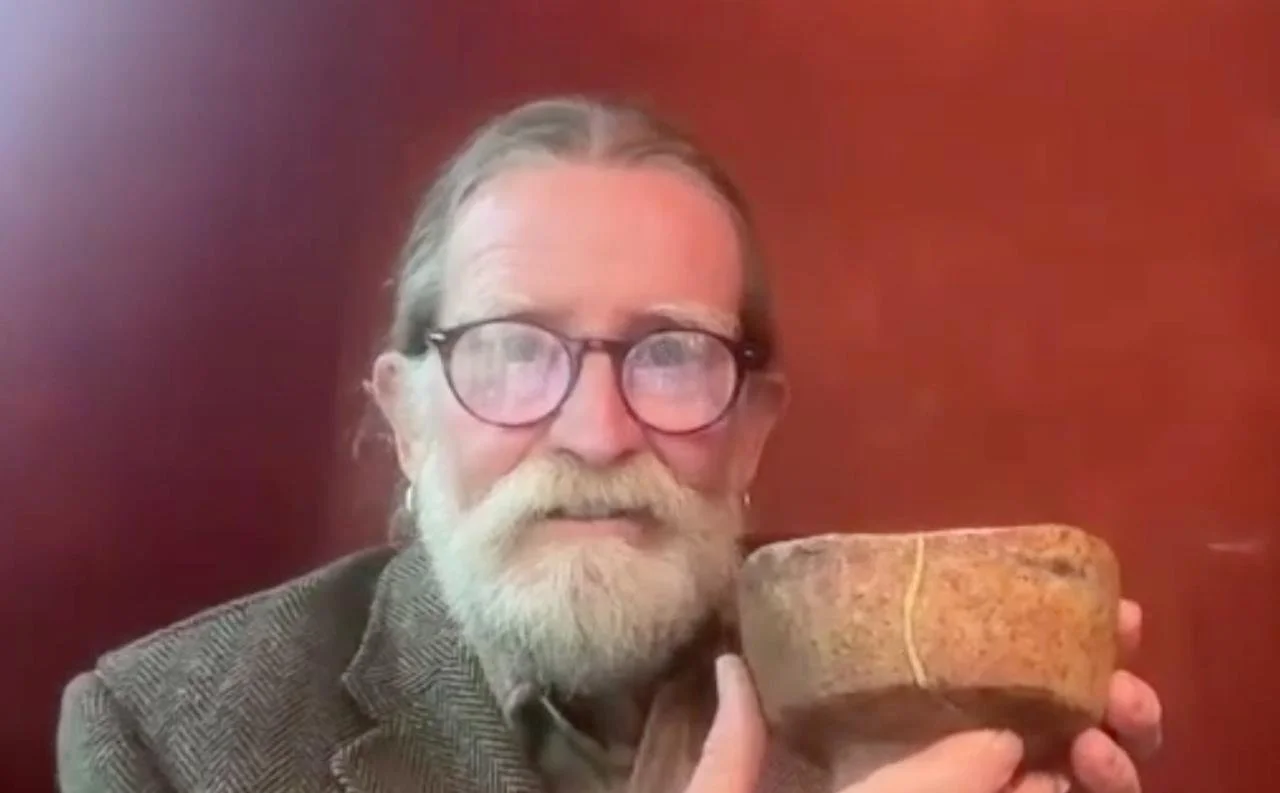
Stephen Jenkinson with his beautiful raku cup✨
Don’t want to miss a thing?
Subscribe (BTW, it’s absolutely FREE) to the show on your favourite platform or app by clicking the relevant button below… That way you’ll receive each episode automagically straight to your device as soon as it’s released!




Thank you!
Lian & Jonathan
Episode Transcript:
Please note: We are a small team and not able to check through the transcript our software provides. So you may find some words are out of place and a few sentences don’t make complete sense. If you do see something utterly ridiculous we’d love you to let us know so we can correct it. Please email any howlers with the time stamp to team@wildsovereignsoul.com.
Lian (00:00)
How might we meet endings on purpose rather than only recognising them after they've already gone, if we even do at all. This week I'm joined by the wonderful Stephen Jenkinson, creator of the Orphan Wisdom School and a grief literacy advocate. We talk about what it's like to turn a lifetime of teaching about dying and death towards his own Parkinson diagnosis and what he's found there that has broken open, humbled and moved him.
Stephen holds master's degrees from Harvard in Theology and the University of Toronto in Social Work. He spent years directing palliative care in a Canadian hospital and in 2010 he founded the Orphan Wisdom School.
We talk about what it's like to have spent decades helping other people to meet their dying and then to have to meet a diagnosis of his own. And that question runs under everything we cover from the childhood illness that may have somehow imprinted him to the raccoon cup he broke and then was mended with gold. We get into the word anesthetic, which you'll see really moved me and how for Stephen splitting it open changed how he understood addiction and beauty both.
Why he pushed back on the word joy and what it means to recognise an ending while you're still living inside it rather than only afterwards once it's already gone. So listen if dying feels like something that will just happen to you one day and perhaps something you'd rather not really think about or talk about than something you're consciously living into.
If you're new here, this is a show about the deeper, truer life, the one your soul is calling you towards. And if you've been here before, you already know that. And that calling is exactly why Unio exists. Unio is the fellowship of wild, sovereign souls where Jonathan and I meet with members twice each month in our guidance circle, to meet you in whatever is alive in your life. That could be your relationships, your soul path, your health, parenting, the places you feel challenged or called or both. Often they show up at once and we bring everything we are and everything we know to meet you exactly where you are and to support you to move forward. You can find out more and join us at wildsovereignsoul.com/unio.
And now back to this week's episode, let's dive in.
Lian (02:32)
Hello Stephen, a huge welcome to the show.
Stephen Jenkinson (02:37)
Thanks very much. Thanks for having me.
Lian (02:39)
really my pleasure entirely. I was just sharing with you that I take every August off as a kind of mini sabbatical. So I've come back specially to have this conversation with you and I can't think of something I'd rather be doing. So yeah, thank you so much for coming on and being willing to have this conversation with me.
Stephen Jenkinson (02:59)
Sure you bet.
Lian (03:02)
So I know that we have so much to explore that you shared in your book, Trembling Still. But before we dive into that, I have a personal I guess interest, passion in the ways that our souls' fingerprints can often be seen way back in childhood. And the path that life takes us on, what we might call our medicine and our wound, are often imprinted in some way or other. Sometimes it's very obvious and sometimes it takes more time to be able to see this. Where we if we look, we can see how that was shown to us way back in childhood. And so I would love to hear your sense of that for you. And I know that you have shared before how you had a period where I think you described you were mysteriously dying and then didn't die after all. So possibly that's the fingerprints, but I would like to ask more openly. It might be you have more that you've seen about that. So in in short, how do you see your soul was already speaking to you back in childhood about the direction of your life and work?
Stephen Jenkinson (04:21)
This is tricky stuff because part of the implication that's buried in the question is the idea that you that this is a kind of knowing and that you're somehow mysteriously in possession of this kind of knowing. And because you are, it's kind of available to you, you know, minus kind of mystery or or or getting it wrong or you know, all that sort of thing. And I'm not sure that it happens that way.
I think there's a degree of mystery about the matter that doesn't give itself away because you happen to be nominally at the center of that mystery from the point of view of the questions that you're asking me. So I suppose you could say that you know, if you're born in a storm, literally, I mean.
If you're born in a storm, which is the stuff of legend, isn't it? And it's the stuff of myth and of course of popular song and the rest. If you are, the chances are that you will be a stormy type. Or the chances are just as good that you will spend a good deal of your life doing everything you can to avoid storminess.
Lian (05:47)
Hmm, but
Stephen Jenkinson (05:48)
So these things are not one for one, right? They tend to, I mean, it's there as a presence and an influence and a consequence. But it's kind of like fate in the sense that, you know, etymologically, the word fate does not mean the fix is in. The word fate comes from the Latin word to fashion or to to create or to conjure. So actually, what fate means is it's a two part proposition. The first half is.
So the gods have spoken. That's what the world is, that's what physics and chemistry are. That's that's all the givens, right? Gravity and all the rest. And the second half of the scenario is what shall you do now that the gods have spoken? So that's open. That's the idea. That's open. And so I don't think by that understanding.
That's things like early childhood illness, which was a fact for me, in and of itself sort of drives the bus, you know. It's a presence for sure. And it's undeniable. Well, that's not true. Everything's deniable, the truth be told. But it's certainly non-negotiable as a presence. Yeah. So I yes, certainly I remember.
I have this is three and a half years old, so it's fairly early on. And I do remember a kind of a clutch of experiences that are so unlike anything that your domestic life readied you for at age three and a half. You know, kind of to be in a hospital setting, an institution, to be in the presence of people I didn't know constantly, to be on the receiving end of a kind of ministration that wasn't benign. It was very intrusive, just physically very intrusive. And all of these things, what do they add up as? And the answer is, we'll see. And I'm still answering that question, how do they I'll add up? Aren't I even up until this present moment wondering about it with you? And there's a certain latitude that's available to you.
But the at the same time, you kind of have an obligation to these matters to find your working relationship with that kid, in my case. What's your working relationship with that kid? How are you having that kid along with you for the ride? Much in the same way you could ask the same question about your ancestry.
How are you having your ancestors along for the ride? It's not passive, right? It's it's work. It's a work, it's a kind of work that's available to you and sort of mandatorily upon you at the same time. Having said that, I'll tell you a brief little story that came from my I would have been in my 30s, I guess, when this happened, which is in other words, half my life ago.
And I was in a program studying social work and I intended to be in some kind of counseling type at the time. And so I was shocked to find that this the regime of study didn't include the obligation to be on the receiving end of counseling, which I thought is just the most obvious and natural thing, but it wasn't there. So I took it upon myself to get counseled and I hooked up with of all things, a very orthodox, very by the book Freudian psycho psychoanalyst. So it was the couch and it was the, you know, all of that. And it was an amazing time and bizarre in ways and unexpected and deeply fruitful, but in ways you never saw coming. There was a moment there.
When we're talking about what you've asked me in a roundabout sort of way, I was talking about my childhood experience there in the hospital and so on. And I was, as one does from time to time, speaking about it as if I was kind of in charge of what it meant. That I had
Lian (10:25)
Mm.
Stephen Jenkinson (10:26)
it in hand, so to speak, you see. And so I was being a bit blithe, wasn't I? Like an idiot. And I was sounding very much at the top of my form on this matter and the rest. So he's just he's listening and not even nodding, he's just listening and and then I I happen to say something in the order of, Do you know, when you nearly die of spinal meningitis at the age of three and a half and so on, th th it stays with you as a kind of imprint on your your sense of what's what's physically possible or bearable or doable or things of that order.
And there's a kind of frailty that comes with the territory, you know, that thereafter. So I'm saying all this to him. And he's not saying a word. And so I finally stop satisfied that I've done justice to the notion, you know. There's a long pause, which is never a good thing. A long pause, and then he says, Interesting mythology. That's all. Interesting mythology. By which he was asking me to reconsider, obviously, at some level. And it was very useful information, that little observation that he made. Because these things are not one for one. Meaning it I don't think it works that this happens, here's the consequence. It's absolutely traceable and a straight line, more or less. I mean, these things are you don't know what they mean. You haven't lived out their meaning yet.
You are on the receiving end of this thing that you call that you claim to be you or yours. But it's not really your personal possession, is it? It's at best you could say it's a bizarre little scheme of things that are entrusted to you by which you might find your way happenstantially. That's as close as you can get to authority. I think on the matter. And it really requires of you that you be at least as humble in the presence of your own life story as you might be willing to be in the presence of someone else's life story.
Lian (12:48)
Mm.
Yes. And as I think you said at the beginning, we'll see. Yeah.
Stephen Jenkinson (12:56)
We'll see. Or we won't.
Lian (12:59)
Hmm. Yes. Something I was really struck by as I read Trembling Still, I'll show it show it I'm sure we'll do both do this a number of times, your latest book, Trembling Still, was the beauty.
And it before you got to the story about the cup, the broken cup, I was already I'm very, I guess you could say attuned to beauty. And as I was reading, I was noticing the way that you're writing about something that you were describing as terrible and terrifying.
Was somehow also beautiful. And then when you were talking about the Japanese cup and how it was a beautiful, the most beautiful thing, and then it was broken and it was no longer beautiful, and then it was mended with gold, and then it became beautiful again. And What I would love to know is whether you're as I see it, and this of course is because of my own I guess, attunement to beauty. I'm perhaps seeing this, and it may not be what's going on for you, so feel free to correct me if that's the case. I was fascinated by what appeared to be the way you're making the terrible, the terrifying, beautiful. And if that was intentional or just you being you and doing things the way that they're coming to you. And if it is intentional, what is the intention?
Stephen Jenkinson (15:01)
Well, very thoughtful question. Let's see.
I'll linger over around the word beauty for a minute here. Because it's an easy enough word to use, But I don't know that many of us have a working understanding of really what that is. Typically the word is used to describe something that is that favours us in some fashion, right? That gives itself away in some way, that's that we find pleasing to ourselves. That it's affirming in some general sort of way that there's a tremendous amount of upside to something when you describe it as being beautiful.
Lian (15:43)
Mm.
Stephen Jenkinson (15:45)
But then you have phrases, you know, that that alter the terrain. For example, terrible beauty. It's a fairly standard poetic phrase. Sounds kind of Shakespearean and sounds very dramatic, sort of Byron-esque, and and and I suppose it is. And you can tell from that, the invitation there is to consider the real possibility that beauty, the principal attribute of beauty is not that it fits nicely into your day. It's just as likely that something that's beautiful brings with it a degree of carnage,
Lian (16:27)
Mm-hmm.
Stephen Jenkinson (16:27)
a degree of devastation, you know, an undoing of your of normally scheduled programming, if you will. In other words, there's a power to beauty that's not just high-fiving the universe. Right? Right. So with that in mind.
I suppose when I was a kid, I probably wasn't that young, but I went to Harvard Divinity School intending to be a preacher of something. The irony being that I'd never been to church, so they wouldn't have me. Not in that program anyway. But the good fortune was at the same week that I was disqualified from getting into the white collar program, I was strangely qualified to join.
As a kind of undeclared apprentice, an old black man who was a storyteller. And he and I and his wife traveled over many places in North America over the subsequent five, six, whatever it was, years. And man, did I ever see the real thing in action? I mean, when I say real thing, I don't just mean his qualities, his capacity as a storyteller, which was epic. I mean
His capacity as a human was beyond your wildest imagining. And he was, among other things, a master of tragedy, which is not to say that he was a master over tragedy, such that tragedy was no longer tragic. I'm saying he was a master practitioner of tragedy. He understood tragedy very well. And he welcomed it into his life and fashioned his life.
As a host to tragedy as much as to beauty, to the point where it's kind of indistinguishable where one ends and the other begins. An example being he and I went to see a film that reminded him about his days taking care of his brother, who at the time was would have been called retarded. And nobody else was doing that work. And he's so he's as an adolescent, he's trying to fend off a mean world.
From his, you know, his compromised brother. His brother subsequently dies. Nobody knows why or how. And we see this film that reminds him of all of this. You know, and we're sitting there afterwards in the theater, silent, right? Everybody else has left. I talking about the film, he's not saying a word. Finally, I say, What did you think? And he says, My heart is broken. I never wanted to mend.
That's what he said.
So you see what I mean? I mean, anybody that can see life that way is an incalculable boon to the rest of us. Really, because he's praying for what? He's praying for a broken heart. Not to be spared or saved the brokenness, but to have the brokenness so available to him that he would never forget it.
That he would remember why he was born in those terms too. See, so I was, I was, I was exposed to all of this at a fairly formative time, as it turned out in my life. And so I didn't have to invent a kind of public, or even a human version of what you and I are talking about now. I simply had to keep my eyes open, which was hard enough.
And my mind open, which was hard enough, and feel not inadequate in its presence, which was hard enough. Because I mean he devastated your capacity for adequacy. He really did. He was a powerful, powerful, frankly shamanic character, right? And I was enormously lucky to be with him at the same time that my subsequent life after that time together hailed in the shadow of it, didn't it?
Nothing was that spectacular. Nothing was that realised or or or cape or possible or and all of that. So man, how do you live coming down off the mountaintop? A life that seemed only possible on the mountaintop. There. There's the throwdown. See. So all of these things for me go towards answering your question about what constitutes beauty. How does it work?
How did it find me? You know, and apropos of the teacup and the brokenness and so on. Briefly for people who didn't haven't are not aware of the story, I was asked in an interview what my most beautiful possession was, which immediately you should be on notice that if you raise up something above everything else, you're kind of asking for it. Right. And that is exactly what happened as you read. No sooner did I take the pack the the teacup from its packaging. It was within ten seconds.
Lian (21:57)
And it'd been there for years as well, hadn't it? Before you
Stephen Jenkinson (21:59)
Yeah, I hadn't seen it for years. That's right. That's right, because it was beautiful and so I was protecting it so I never saw it. As we can often do with beauty, right? We sequestered a way to preserve it and in so doing lose any touch with it at all. Which really begs the question, is that what it's for? Of course. But anyway, yes, I took it out of the box, being prompted by the question from the interview and dropped it. You know, and And man, I heard that crack. I heard it. Because it was a not porcelain, it was raku teacup. And anyway, my understanding of its beauty was gone. Or I should say I understood that its beauty was gone. That's a better way to say it. gone as a consequence of this terrible inattention, this terrible neglect on my part. And
Long story short, somebody offered to get it fixed. I figured there's no fixing this. Or if it was like a smoke and mirrors fix, you know, where you invisible mend, you can't see it and all the rest. And what the Japanese fixer did was exactly the opposite. The fixer emphasized the crack, underscored, italicized in bold type the crack with, as you said, gold of all things. And the I mean the most beautiful denouement to the story is when I finally take receipt of this fixed teacup.
I hadn't seen it in years. I'd given up on it entirely. And the person who'd done the work on my behalf and myself, we poured hot water into the teacup, not even tea, just warm water. And we looked down, and there on the surface of the water was gold dust. And that's what we drank.
Lian (24:04)
Mm.
Stephen Jenkinson (24:06)
And it was I mean, you can't get more sort of mythically intact than that, right?
Lian (24:12)
Yeah.
Stephen Jenkinson (24:13)
Okay. Well, can I add one more thing here? I know this is going on a bit, but it's a great question.
Lian (24:17)
You absolutely can, but just before I forget to say, I would absolutely love to see a picture of the the cup if you wouldn't mind saying
Stephen Jenkinson (24:26)
I can do better than that. I can go get it and show it to you.
Lian (24:28)
I was going to ask that and I like, that's probably a bit too cheeky, but yes, I'll accept if you're willing to.
Stephen Jenkinson (24:34)
I'll go get me a second, I'll be right back.
Lian (24:37)
Thank you so much.
Stephen Jenkinson (24:45)
Okay. I mean, with all that build up it's not gonna possibly carry the weight, right?
Lian (24:53)
It's got a big lift myth to live up to.
Stephen Jenkinson (25:00)
So this it's very irregular as you can see.
Lian (25:02)
Yeah.
Stephen Jenkinson (25:04)
And then I'll rotate it around so you can see where the crack was and still is. And so that's the inside. You can see quite irregular. Beautiful foot on it there. And then if we rotate around, I don't know if you can make it out, but
Lian (25:20)
And it does live up to it. It's so beautiful. Would you mind showing me the inside again?
Stephen Jenkinson (25:27)
Here I'll tilt it up so you can see the gold at the top there.
Lian (25:32)
I love it. It's like a sort of lightning fork or a snake's tongue. Exactly.
Stephen Jenkinson (25:36)
Exactly like a lightning fork or a snake's tongue, exactly. Yeah. So there it is.
Lian (25:43)
Well, I've got my wish come true. I've seen the cup.
Stephen Jenkinson (25:47)
Cup. That's the very cup. Yeah, that's right. So the story I was going to tell you was so I have to have a band, and we've been able to tour for years, and the material that is all original stuff that we perform. And some of it comes, a lot of it comes from me. And this particular story occurred to me, and we called it fentanyl for a long time. And then I realised, you know, if the powers that be who are behind fentanyl ever hear about me doing this. They can afford lawyers much more than I can. We'd be ri in real trouble. So I changed the name of the story to Beauty Bereft. Yeah. And in it I began by saying something like every weekend pouring down from the North American suburbs, young people looking for a good time, coming downtown. That's how it begins. Doesn't sound very ominous, but it becomes ominous fairly quickly because it's it goes to the frank sort of opioid addiction that is all over the Western world at this point in time. And then I stopped. The thing and I wonder about the word anesthetic because that's what opioids are. They're not hallucinogens or anything like a mood alterers of any kind. They're pain relievers. What pain though? There's the question. What pain are they relieving? See, so that's what I started to wonder about. And I did so by using the word anesthetic.
And I realised something in that moment that had never occurred to me before. That the word anesthetic is made of two parts. The first part is the negating prefix, right? Means non or un or something like that. And the root word is what?
Lian (27:48)
Oh, my gosh, aesthetic.
Stephen Jenkinson (27:51)
Exactly.
Lian (27:52)
Goodness.
Stephen Jenkinson (27:53)
So what does an anesthetic do? The answer is it disables you where beauty is concerned.
That's what it does. And so I asked the question: who would disable themselves where beauty is concerned? Who would do that to themselves? And the answer I came up with is the beauty bereft. Those who've been obliged to live minus the understanding and the direct corporeal encounter with beauty, which is an increasing part of the population, sadly. So these are very very important question you asked here, with a lot of very important kind of details that fall out from it, you're right. And and you're you're very kind to to suggest that I have a sort of beauty making capacity with the language. And you know, I won't pretend that I'm not aware of what you're referring to and that I don't take genuine pleasure in it myself when it becomes available to me. I do. And am I proud of it? Completely. Am I unnecessarily timid on the matter? Not really, not at my age. I have nothing to be timid about. But I do feel lucky that I've been granted the possibility to hear the language in such a way that I can lend whatever skillfulness I have to the circumstances of the moment. And very often the translation is successful.
Yeah. So I felt the obligation when I was writing Trembling Still to not abandon what I had been entrusted with skill wise.
While at the same time trying to inhabit faithfully the terrible, the awful clarity, as I called it in the subtitle. The awful clarity that had come around as a result of the diagnosis that I very unexpectedly was saddled with. So, long story short, then it's not only possible, but it may be mandatory to not abandon your understanding of beauty in a time that seems so achingly unbeautiful.
Lian (30:17)
Mm.
I feel a bit lost for words. There was something about the in particular, the root of anesthetic that's I feel like I we could have a conversation that goes on for days just about that. So I'm just kinda gathering myself because I want to ask you something else. But yeah, it's
Stephen Jenkinson (30:50)
dizzy. Yeah. It's heartbreaking. It is.
Lian (30:55)
It is
Stephen Jenkinson (31:02)
Which beauty is sometimes, isn't it? We both know that. Yeah.
Lian (31:07)
It brings me to something else I was wondering actually quite well. Towards I think it's towards the end of the book. Let me see if I can find the place it might be Let me find it. Whilst I somewhat pull myself together.
Well, I'll trust you, remember, I'm sure you will. Okay. I can't find it in this moment. You talk towards the end of the book about joy and sadness and it made me recall a couple of things. In the book of the Prophet, it's as I'm sure you know, he talks about how sorrow kind of hollows out the cup so that we can be filled with joy. And I was also thinking of Martin Prechtel and how he talks about grief and praise being not opposites but almost married. They kind of show up together if we are open for them to do so. And it feels as though this this is akin to what we were talking about the broken heart and the beauty and there isn't necessarily a clear question, but there is something in this I think these things can sound like good ideas, you know, this idea that sorrow that kind of carves us out to experience joy. Yeah. but of course, we do actually need to experience the sorrow. Experience like be broken open by the sadness. and so I'd just love to hear you say more about that. It was kind of a in some ways I think there was it was the culmination perhaps of everything you'd written in the book, but you didn't say huge amounts about it. It was quite a short passage. And so I'd love to hear more that you've seen about that.
Stephen Jenkinson (33:26)
Well, I think I like your instinct about let's call them slogans. You know, kind of easy formulations that are ultimately recipes for victory and heroism and prevailing against the odds, you know, all of that stuff. I mean, I'm deeply mistrustful of anything that s has that smell on it. Mm-hmm. You know, I try to I hope I successfully more or less avoid slogans of that kind myself. So There's nothing inevitable about suffering producing joy or anything else. Come on now. If that's the case, you should be looking after sorrow and devastation and the rest, because what's sure to follow is a guarantee of the upside, kind of thing. Right? And there's nothing true about that. So
The work involved in being hurt.
There's a thought.
That hurting is labour.
It's not victimisation.
I'm not saying that there's not really hard times that come with that. I'm not saying there's no such thing as quoke trauma and all of that stuff. I'm just saying that along with that, we'd be well served, I think, to credit the possibility. That hard times ask more of us than they do to us.
If we can bring anything like not an open mind, what would I say? Anything like just some kind of psychic capacity to bear upon the the circumstance, right?
Heartache.
We know there's such a thing as heartache or heart brokenness. Is there such a thing as mind brokenness? If there is, how would it be the same? Or how would it be different?
Because, you know, in my circumstance, the diagnosis I have says that my brain is dying slowly but perceptibly every day. And I should say every night. Such that I wake up, you know, many mornings, not so much now, but certainly at the beginning, wondering who's waking up compared to who went to sleep. Right? I don't know who's there. And when the brain is, you know. Part of the story. These are very active and alive questions. But Joy, I mean, I tend not to use the word largely, be maybe I'm just simply not that good at it. And maybe that's why. Over and above that, maybe too my instinct is that joy is a little it's a little overblown. You know, it's just has too much wind blowing through it, if you will. It's too exceeding. So maybe something like sense of well being, might suffice, or a sense of good faith engagement. Maybe something like that, you know. So in other words, if joy is as if joy tends to be hard on the rest of the story, doesn't it? Joy tends to be kind of intolerant of everything else that's not joy. When in actual fact the rest of the stuff kind of belongs. In fact, you could go further and say, if you don't have the rest of the stuff, Joy is kind of hard to recognise. It might even be hard to register upon you. So the other thing I'd add there would be something like maybe gratitude. That maybe what gr what being grateful is, is joy engaged. Joy active. And where does gratitude come from? Does it come from everything working out? eventually to your favor? No, it doesn't. If it did, very few of us would be capable of gratitude. I think gratitude tends to be a consequence Of you not losing track of all those times when things weren't working out, when life wasn't particularly good, which are real things. That wasn't you in error, and the only time your mind is working clearly is when you're joyful. I mean, that's just not that just ain't it. You know, so if we can spare some credit for the hard times and the hurt. then the likelihood is that our capacity for gratitude is not waiting for the silver lining. That our capacity for gratitude might be the silver lining.
And it doesn't need the coast is clear first to show itself.
Lian (38:59)
Yeah.
Mm.
I would like to move somewhere that and it might be you say there isn't anything more to say about this. It was a particular line in your book that for some reason really struck me as something that was more than just a line in that particular passage. if I might read it, it's from the entry of twenty seventh of January twenty twenty four. Actually before I do that, I'll also say that I often notice when words have been used more than once by someone, and the passage is about the desert, and I also noticed you talked about a decade in the desert in your biography. And so I think that that was part of The line here was what just struck me first and then I happened to notice where you use the word desert again there. and so the paragraph is if as if I'm alone on the only mountain top in sight. No, the cactus desert. I'm alone in the desert with God. Only God doesn't think I'm in the desert, nor agrees that I'm alone.
Right. When I read that I kind of I think I had a bit of a kind of catching flies moment where my mouth just opens and I was like That doesn't feel like just Stephen Jenkinson writing about his experience in this moment. There is something in that that's for all of us at all times. That's how it landed for me. And so, It's a very inelegant question, but I just would love to hear your sense as to what might have been it feels to me like it's almost a seed and I'm kinda wanting to know what does that seed bloom into? What what's there for you?
Stephen Jenkinson (41:21)
Sorry now, just so I follow you correctly. The seed you're referring to is what? huh.
Lian (41:27)
I think the line itself feels like the seed is it's more than that moment in that day of the twenty seventh of January. And so if this I'm alone in the desert with God, only God doesn't think I'm in the desert, nor agrees that I'm alone, what might that be?
Stephen Jenkinson (41:51)
Twenty seventh, was it? What's the page number?
Lian (41:53)
It's forty three.
Stephen Jenkinson (41:59)
Well I as I remember. That's right. This the entry of January twenty seven is a sequence of analogies, if you will. It occurred to me as I was trying to like I should say, when I'm writing this, I'm not rereading it and proofreading it and all the rest. I mean, I can barely survive the writing of it and putting the pen down and trying to walk away. That's what it was at the time. Not for this passage only.
But routinely, that's what it was. That's what the experience was. In this particular case, there's nine or ten for of the same formulation. It is as if what I'm trying to do is find, let's call it a livable.
sort of psychic framework that I can accommodate myself to in order not to go mad. Okay? Because the terror and the sort of grotesque disillusionment that followed the in the wake of the diagnosis was so acute, so pervasive, so unrelenting that these things were ironically me trying to describe it.
Was me trying to find a way to live it.
Right. So there's a number of them. I mean the first one is as if a beaker made of fine glass has tipped over in my mind, and some vital violet liquid is leaking out of its water course and trickling out to sea. So this is a way of me saying I feel myself to be ebbing.
That there's a brokenness through which something vital and irreplaceable is leaking. You can hear I'm literally talking about my brain here at some level, right? But I'm finding different ways to approach it that become that can be recognisable to me. And the one you're talking about is close to the end.
The one prior to it says, It is as if all day long I spend myself pushing this weighted halting pen across acres of empty page, as if pushing a blunt stick through wet clay to write messages of plea and warnings of eclipses and landslides, and the wash of my own attention has scoured them away.
It's impossible, you see. It's a rendering of something that's psychically impossible. It is this as if I'm alone on the only mountaintop in sight. No. The cactus desert. I'm alone in the desert with God. Only God doesn't think I am in the desert, nor agrees that I am alone. So I'm very proud of those formulations in case it doesn't show.
Lian (45:31)
Rightly so.
Stephen Jenkinson (45:32)
Yeah, I'm I'm I'm very fond of the achievement. And the one you've pointed out to is particularly close to me because it was my theology, such as I have such a thing, is there, you know, and it's it it simply has it imagines divinity as neither pro nor con, not with me. Not against me, but somehow alongside me in the time when I least suspect it to be true.
And so, and of all the ways to be companioned by the divine, my characterization here is I'm certain about the nature of my devastation, only to imagine the real possibility that God simply doesn't agree. Doesn't agree at the characterization of the desert, nor the characterization of my aloneness.
And it doesn't say everything's gonna be okay. Not in the least is that part of it. It simply says God is otherwise. You have your understanding of the presence of the divine in your life, and the divine is otherwise.
And maybe, and that's all it is, maybe this otherwiseness, this kind of rupture in your certainty is just enough to be what Leonard Cohen, God bless him, was so skillful in articulating where it when he said, Of course, there's a crack in everything, that's how the light gets in. Right. So I'm not comparing myself, I'm just saying I recognise the territory he was talking about.
And it's, I think, recognizable in that thing about the desert and about God. And it's no surprise. I mean, I'm not the first one to bring God and the desert together. I mean, this is a very, very old tradition, right? And we should say as a PS that the word desert doesn't imply that there's nothing alive there. The word desert simply means if you're used to the forest or the meadow, the desert is a rough go.
And it doesn't spring into bloom except on the very odd time when there's mist, or a bit of a shower. And then all this unsuspected life leaps forward for a time.
Maybe that's what human life is. Just enough mist to cause you to burst into bloom for a while.
Lian (48:28)
Mm.
Thank you for sharing more about that. There's You know, some phrases ask you to walk with them, be their companion. It feels to me that those lines are there for me like that and what you've shared has added to that sense. Thank you.
I know that we are coming up on time, so if you would permit me one final question. And ironically it's about endings as we end this conversation, but there's right towards I think it's probably in the epilogue, you talk about how we this is me paraphrasing,
In fact, I'll just read this one part of it. The attention span needed to heed an ending is a mighty business. And then you go on. And it seemed to me you are making the point that we don't know. We don't know there is when something begins, we don't know when something ends. sometimes we figure it out afterwards. And I was brought to mind both of my parents died relatively early and both very suddenly. And so there literally wasn't you know, they didn't know that they were going to die. There was no my father was killed in a road traffic ac accident, my mother went into a coma and so you know so in some way she may have been conscious but the point where we turned the life support machine on from a kind of modic medical modern sense she wasn't aware so neither of them seemingly were aware that there was an ending approaching and we weren't aware there was an ending pro ending pro approaching at all either. It was there. And It feels as though there is a perhaps the sort of English woman in me feels like what I'm about to ask is a insensitive question, but it feels important to ask you. And it's something like given what your work has been about, your life has been about, and the diagnosis, how it's called you and given you the opportunity to as much as you can pay attention to the I think you described it's almost like the little deaths to the ending, to to be aware of the ending. And again, juxtapose with my parents' experience where that's another extreme. There was no awareness of an ending. And so It it may be a question that is still being answered within you, but I just wondered whether you had thought about that at all, the fact that many people don't have that awareness all the time, the opportunity to pay attention to see if they can see the ending, and what your sense was that you've you have that.
Stephen Jenkinson (52:07)
Mm-hmm. Not insensitive at all. well, first of all. I don't think it's accurate. It's certainly not helpful, but definitely not accurate to think that, quote, you do not have the opportunity, unquote, to court this thing called ending. It's factually inaccurate to say so. By which I mean what? it's true that for the most part, the time and the place and maybe even the cause of your Medical demise is unknown to you.
But that doesn't mean that your death is unknown to you. That means the details are unknown to you. But the entrails are not. This is entirely available to you as even a vaguely conscious human being. You are surrounded by frailties and limits and endings of all kinds. They're coming in over the transom fairly constantly. So for you not to be quote aware of this is a comment about your truancy, not a comment about life. Right?
And everybody's death around you before your own, what is it? It's your chance to get a bit of a PhD in the way it is, isn't it? So you don't come to your dying as an amateur or as a foundling or as a rookie. Very unbecoming. And making terrible problems for the people around you as a result. So What has this quote done for me or to me with this in mind?
Alas, inevitably, nothing. In other words, I used to say when I was working in the death trade in palliative care, I used to say, My God, what does it take? You know, the person's got a terminal diagnosis, they've got all the symptomatology they need to not lose track of it. And yet, with all of that, how does it go? And the answer is they forget and they forget.
And yet again forget, right? So I would say, what does it take for us to stay, let's say, inside the postal code of our dying? That's close enough, right? Just there. And I honestly don't know the answer as if there's something that's guaranteed to keep us there, guaranteed to keep our minds alert on the matter. I don't think there is anything.
So then you realise death literacy, if I could call it that, is a practice. It's not an achievement. It's a practice. You know, you probably know this better than I. You don't do your yoga, maybe your pelvis will tell you very soon you're not doing your yoga. Or your hip joints or whatever it is, right? You'll find out you're not practicing. Well, it's the same with this. If you're not practicing endings, then every ending will seem like a betrayal, will seem like an offense, will seem like it doesn't belong, that it's unbecoming, and the rest. In actual fact, endings are becoming.
They are. And they're one of the ways by which you can yet again inhabit the seat of your own little life now. There's nothing to wait for. I mean, P.S. This is the end to my I answer this particular thing. So I get the diagnosis, and within a week or maybe two, I'm in another country.
In one of those God help us Airbnb things and you know, where everything's beige, that sort of stuff, and replaceable. And I'm just destitute. my god. Like I can't I literally can't get up and walk around, you know. And I'm surrounded by the clearly the owner of the place has a kind of eastern religion orientation to his or her life.
And in just sheer despair, I see this book on the shelf and it's wide. It's like it's a big wad of a thing. And it the covers or the the spine says something like thoughts for the year or I don't know what three hundred and sixty five notions, right? And then you're supposed to track them and this is supposed to help. Anyway. So in just desperation, I just flip it open, kind of e Ching style, right? Just let it drop open. And what do you think is facing me? What do you think it says? And of course, this is how it works, right? It says the problem is we think there's enough time.
That's what it said. So I didn't go, hallelujah, you know, and run out the door crying and proclaiming. That's not what happened. But I remember that pretty clearly as another opportunity to get it right.
The problem is we think there's enough time means we genuinely do put off the work of ending until we have no choice. I promise you, having seen a lot of endings, that you'd rather practice ending and then be able to set it aside to go make a really nice sandwich. Or, you know, whatever the circumstance might be. You really would, because the time will be coming when you'll be making that sandwich in a world of hurt. You understand what I mean? So you don't need to wait until then for this to be deeply available to you. It's available to you now.
But man, there's nothing to wait for. It doesn't get truer than this. And so there's nothing in getting a diagnosis that quote helps, not really. But it can bother you enough to get your attention.
Lian (59:15)
Mm.
Stephen Jenkinson (59:16)
And I guess we could use that. The track record seems to suggest that we do need some reminding about the details and the facts of our own little lives.
Lian (59:29)
Yeah.
There's I think it's just as you end the book, you say something like, as you're talking about here, if we've witnessed other people's deaths, we can learn from them, apprentice to them, let them have their way with us. And you end by saying, I sent this out into the world in case I could be a someone else to you.
Right. And I really felt the I guess generosity in that. And so I wanted to thank you from the bottom of my heart for being that in the book, in this conversation, in your life, in your work.
Stephen Jenkinson (1:00:33)
you're very welcome. Thank you too. I mean, you can guess that there are some personal motivation reasons why you undertake something like this. And then there's another layer, which is more to do with wouldn't it be something if there could be actual genuine merit available to others by virtue of your attempt to get the score, I mean the melody, the score and the libretto of a few moments of your life just clear enough that they're translatable to somebody else. That's a kind of gold. Isn't there? There's a kind of there's a kind of gold about that. Yeah. I think that's who we can be to each other. So you know, on a good day I remember that. And the rest of the days, which are numerous, I forget it completely.
Lian (1:01:35)
Yeah.
Well thank you so much. where can listeners find out more about you, the book, your work, and I know you also got some upcoming musical things to share too.
Stephen Jenkinson (1:01:54)
But the musical thing is I'm lucky enough to have a band who more than puts up with me, but they actually bring their musical genius to bear upon things that I've written and thought about. It's called Nights of Grief and Mystery. That's the name of the event. And you know, I obviously like everybody else, I have a website and it's to be found there. You could look up Nights of Grief and Mystery, or you could look up the generic name of the website, which is orphanwisdom.com. Or just my name, Stephen with a PH Jenkinson. And it'll end up, you know, crashing into the same cast of characters one way or another. And we're touring with the band. We got a new record. That's what it looks like in C D form. It's called, if you can make out, caldera, which is a kind of volcano, and it's a kind of mouth of an active volcano, isn't it?
And it's a love record. They're love songs, but they're not mostly romantic of that ilk, right? They're mostly grown up encounters with love. Yeah. So that's there. And then as you say, the new book is around and evidence suggests that I'm not quite done. So stay tuned.
Lian (1:03:27)
my goodness. Thank you so much. Thank you so so much.
Stephen Jenkinson (1:03:30)
Thank you too. Thank you too.
Lian (1:03:33)
It's been truly wonderful.
Lian (1:03:36)
My goodness, what a beautiful conversation. Here's three things that stayed with me. What living without beauty or the ability to perceive it might be really costing us as a culture. As you saw or heard in the episode, that was something that brought me to tears and has been really present for me ever since.
Gratitude, understood in the way that Stephen spoke about, isn't the reward for hard times passing. It is what becomes available when those hard times are held and honoured rather than just forgotten once things become easier again. Knowing that death is inevitable changes very little on its own. What matters is an ordinary daily practice of staying inside that knowledge.
Rather than only recognising it as an ending once it's already passed. If this conversation has stirred something that you want to follow deeper, that's exactly what our UNIO guidance circle is for. UNIO is the Fellowship for Wild Sovereign Souls, and twice each month Jonathan and I meet with UNIO members to meet you in whatever is challenging you, calling you, or both, to meet you exactly where you are and to support you in moving forward.
The link for that is Wild Sovereign Soul.com slash Unio. All the show notes and links, including to Stephen's work and book, are at WildSovereinsoul.com slash podcast slash five six four. And if you don't want to miss out on next week's episode, follow or subscribe wherever you're listening. Until then, I'm sending you all my love as you walk your Wild Sovereign Soul path.